Author: admin

  • The Origin of the Five Sacred Mountains 五岳的由来


    玉帝正和王母娘娘商量为女儿挑选夫婿的事。王母娘娘说:“这儿天灵选夫婿的事,这么多神仙,选哪个最合适呢?”玉帝想了想,说:“我看就从我那五个保驾天将中选一个吧。”

    The Jade Emperor was discussing the selection of a husband for his daughter with the Queen Mother of the West. The Queen Mother said, “Regarding the matter of choosing a groom from the heavenly spirits, with so many immortals, who would be the most suitable?” After a moment of thought, the Jade Emperor replied, “I think we should choose one from among my five Heavenly Generals of the Imperial Guard.”
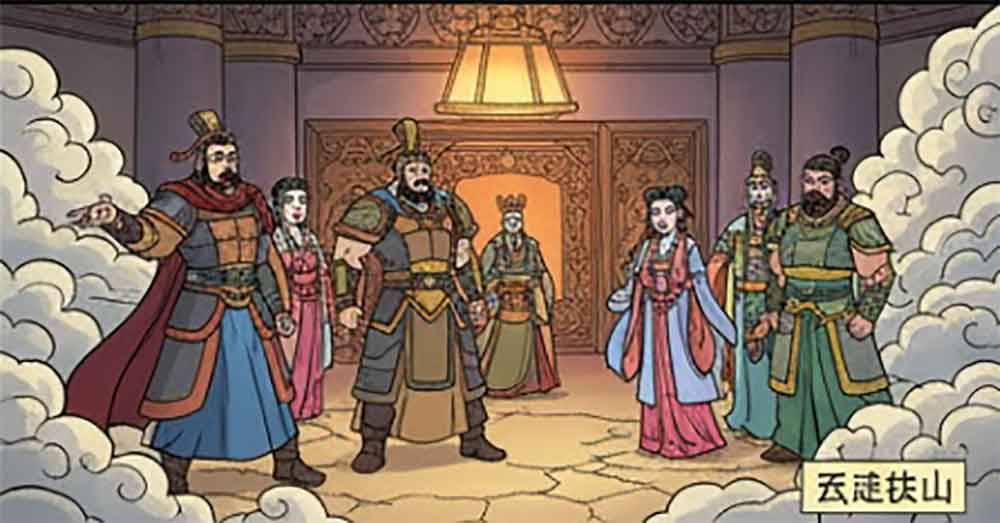

    可是,到底选谁吧?保驾天将有五个,玉帝也拿不定主意了。这五个天将,个个相貌堂堂,威风凛凛,各有各的长处。

    But who exactly should be chosen? There were five Heavenly Generals, and the Jade Emperor was undecided. Each of these five generals was handsome, awe-inspiring, and possessed his own unique strengths.


    正在为难的时候,一个天官匆匆忙忙地跑来说:“玉帝,不好了!人间有难了!东方出了水怪,西方出了风魔,南方出了火妖,北方出了冰兽,这四大妖怪扰得凡间大乱了!”

    Just as they were feeling conflicted, a celestial official rushed in and reported, “Your Majesty, disaster has struck! The mortal world is in peril! A water monster has appeared in the east, a wind demon in the west, a fire spirit in the south, and an ice beast in the north. These four monsters have thrown the mortal realm into utter chaos!”


    玉帝一听,马上召集诸神开会。王母娘娘悄悄对玉帝说:“你不是说你的保驾天将很厉害吗?你就派他们去吧,谁的本领大,我们就选谁做女婿。”

    Upon hearing this, the Jade Emperor immediately summoned the gods for a meeting. The Queen Mother whispered to him, “Didn’t you say your Heavenly Generals are very powerful? Send them down. We shall choose the one with the greatest skill to be our son-in-law.”


    “但是,四方有难,却有五个天将,怎么办?”王母娘娘说:“你把他们召来吧,我先比较一下。”五个天将都来了,王母娘娘一看,确实个个都很威武。她仔细观察了一下,对玉帝示意:“那个稍瘦的留下吧。”于是,玉帝就派其他的四个天将去除妖了。

    “But there are troubles in four directions and we have five generals. What should we do?” the Emperor asked. The Queen Mother replied, “Summon them here; let me compare them first.” When the five generals arrived, the Queen Mother saw that they were indeed all very valiant. After observing them closely, she signaled to the Emperor, “Keep the leaner one here.” Thus, the Jade Emperor dispatched the other four generals to eliminate the monsters.


    这个被留下的天将不知道从哪里听到了原来玉帝和王母娘娘是为选女婿而派他们去。如今除妖,于是他跑到玉帝跟前说:“玉帝,东南西北都有天将把守除妖,这中原就空虚了,如果不及时部署,恐怕妖怪就会乘虚而入,到时候问题就大了。”

    The general who remained somehow heard that the mission was actually a test to choose a son-in-law. Since the others were out fighting monsters, he ran to the Jade Emperor and said, “Your Majesty, while generals are guarding and fighting in the East, West, South, and North, the Central Plains are left vulnerable. If we do not deploy defenses there in time, I fear monsters will take advantage of the void, and the trouble will be even greater.”


    玉帝一听,觉得有道理,于是派这第五个天将去了中原。为了比较几个天将的能耐,玉帝和王母娘娘特地到南天门观战。

    The Jade Emperor found this logical and subsequently sent the fifth general to the Central Plains. To compare the abilities of the generals, the Emperor and the Queen Mother went specifically to the Southern Heavenly Gate to observe the battles.
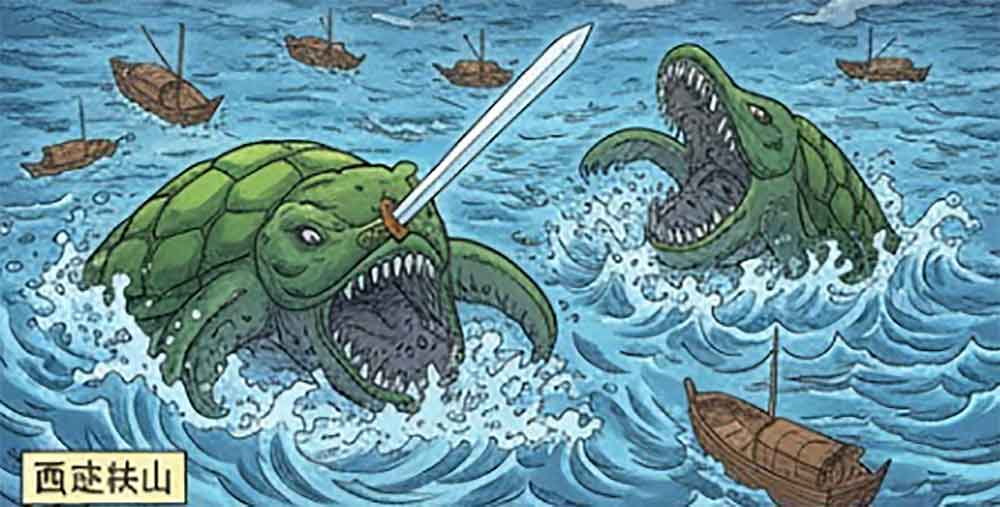

    东方的大海,一头巨大的水怪正在疯狂地吞吃海上的渔夫和渔船。只见天将挥动斩妖剑,向水怪一刺,一下刺在水怪头上。砰的一声,水怪倒在了地上,血肉横飞,天将立即用一座大山压住了它。玉帝看了拍手叫好,给这座山取名“东岳泰山”。

    In the eastern sea, a massive water monster was ravenously devouring fishermen and their boats. The general brandished his demon-slaying sword and lunged, piercing the monster’s head. With a loud crash, the monster collapsed, and the general immediately pinned it down with a great mountain. The Jade Emperor clapped in approval and named the mountain “Mount Tai, the Eastern Great Mountain.”


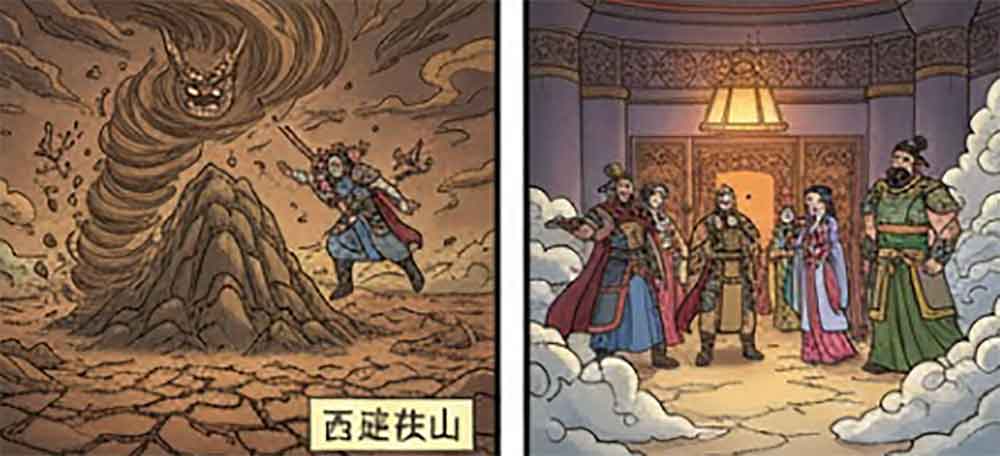
    玉帝又看西方。风魔卷着沙石向大地恶狠狠地扑来,所经之处一片荒芜,没有一点儿生机。只见天将将手中的束魔绳呼呼抖动,风魔马上被捆住了,不能再向前。它所卷起的沙石哗哗地落在了地上,一会儿工夫就堆成了座山。

    The Jade Emperor then looked to the west. A wind demon was sweeping across the earth with sand and stone, leaving desolation and death in its wake. The general shook his magic demon-binding rope with a whirring sound, instantly binding the wind demon so it could no longer advance. The sand and stone it had carried crashed to the ground, piling up into a mountain in no time.


    山越堆越高,最后风魔无力地一头栽在地上。大山压在风魔身上,风魔也被制伏了。玉帝哈哈大笑,为这座山取名“西岳华山”。

    The mountain grew higher and higher until the wind demon finally collapsed exhausted. The great mountain pressed down upon it, and the demon was subdued. The Jade Emperor laughed heartily and named this mountain “Mount Hua, the Western Great Mountain.”

    玉帝又往南边看。只见一个巨大的火球在地上飞来飞去,地上成了一片火海。天将抓了一把神泥,向火妖投了过去,这神泥软乎乎的,立即就把火妖罩住了。火妖拼命挣扎,泥也随着膨胀。最后,泥浆被撑成了一座大山,火妖再也动不了了。玉帝便乐呵呵地把这座山命名为“南岳衡山”。

    The Emperor then turned his gaze southward. A giant fireball was flying across the land, turning the ground into a sea of fire. The general grabbed a handful of divine mud and threw it at the fire spirit. The soft mud instantly enveloped the spirit. As the fire spirit struggled desperately, the mud expanded with it, eventually hardening into a great mountain. The fire spirit could no longer move. The Jade Emperor cheerfully named this mountain “Mount Heng, the Southern Great Mountain.”


    这个时候,北方的那头雪白的冰兽在空中哈着气,把飞鸟、走兽变成了冰坨。天将抱着一个葫芦,对准冰兽开始念咒语,不一会儿,冰兽便被吸进了葫芦里。但用什么塞子塞住葫芦呢?天将想到了一个办法:把葫芦口朝下插进地里。

    Meanwhile, in the north, a snow-white ice beast was exhaling frigid air, turning birds and beasts into blocks of ice. The general held a magic gourd and began chanting incantations at the beast. Before long, the ice beast was sucked into the gourd. But what could be used as a stopper? The general thought of a solution: he thrust the mouth of the gourd downward into the earth.


    这时候葫芦开始胀大,不停地胀,不停地胀,冰兽仍然出不来。最后,葫芦胀成了一座大山,不动了。玉帝马上为这座山取名“北岳恒山”。

    The gourd then began to expand, growing larger and larger until the ice beast could no longer escape. Finally, the gourd transformed into a massive, immovable mountain. The Jade Emperor immediately named it “Mount Heng, the Northern Great Mountain.”


    妖魔都被制伏了,可是到底选谁当女婿呢?他们个个都很出色呀!玉帝正犹豫着,忽然,中原冒出一座山,原来是山怪。它越长越高,直冲着天庭而来。

    The demons were all subdued, but who should be chosen as the son-in-law? They were all so outstanding! As the Jade Emperor hesitated, a mountain suddenly erupted in the Central Plains; it was a mountain monster. It grew taller and taller, reaching straight toward the Heavenly Court.


    玉帝正紧张呢,第五个天将出现了。他拿着把大刀在山顶飞来飞去,谁也看不清他在做什么。过了一会儿,他停了下来,山怪也停止了生长。

    While the Emperor was panicked, the fifth general appeared. He flew around the peak with a large blade so swiftly that no one could see what he was doing. After a while, he stopped, and the mountain monster ceased its growth.
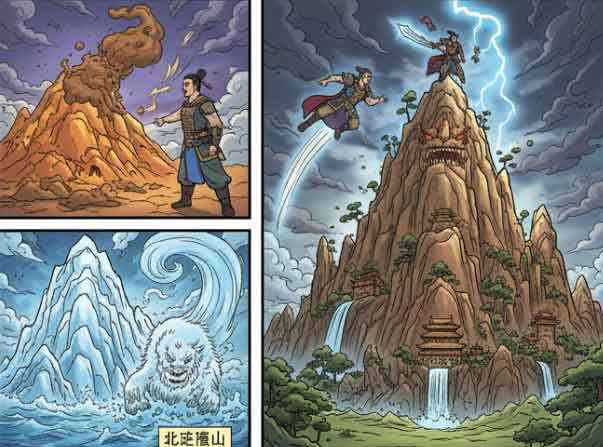

    大家一看,原来山怪已经被天将修成另一个样子了,山上出现了很多俊美的山峰。玉帝半天才缓过神来,他高兴地说:“这个天将不简单嘛,文武双全,我们就选他做女婿了!这座山,就叫中岳嵩山!”

    Everyone looked and saw that the monster had been carved into a new form, adorned with many beautiful and elegant peaks. It took the Jade Emperor a long while to recover his composure. He said happily, “This general is truly remarkable—skilled in both martial arts and the arts of design. We shall choose him to be our son-in-law! And this mountain shall be called Mount Song, the Central Great Mountain!”
  • The Four Tribes of the Naxi People 纳西族四部落

    古代纳西族有四个氏族部落:禾部落、梅部落、束部落和叶部落,又叫禾墩、梅墩、束墩和叶墩。有“禾、梅不离居,束、叶不分家”的说法。据传,禾、梅两个部落居住在金沙江东岸沿江峡谷,即现今的盐源、宁蒗等地;束、叶两个部落居住在金沙江西岸峡谷一带,即现今的丽江、维西等地。

    In ancient times, the Naxi people consisted of four clans or tribes: the He, Mei, Shu, and Ye, also known as Hedun, Meidun, Shudun, and Yedun. There is a saying that “He and Mei never live apart, and Shu and Ye never separate.” Legend has it that the He and Mei tribes lived in the canyons along the eastern bank of the Jinsha River, in areas known today as Yanyuan and Ninglang; the Shu and Ye tribes lived in the canyon areas on the western bank, covering present-day Lijiang and Weixi.


    禾、梅、束、叶四个部落的姓氏是怎样来的呢?相传,远在公鸡还在老林深处搭窝的时候,纳西族的血脉传到了猎人高楞趣这一代。高楞趣有四个聪明的儿子,老大叫趣若的,老二叫趣若吕,老三叫趣若斯,老四叫趣若鲁。

    How did the surnames of these four tribes—He, Mei, Shu, and Ye—originate? It is said that long ago, when roosters still built their nests deep in the old forests, the Naxi lineage was carried by a hunter named Gao Lengqu. Gao Lengqu had four clever sons: the eldest, Qu Ruodi; the second, Qu Ruolü; the third, Qu Ruosi; and the youngest, Qu Ruolu.


    高楞趣是个出色的猎手。雪山岔口上看得到他的影子,雪羊行走的陡壁上留着他的脚印,密林深处有他粗犷的呼喊声。他看一眼野兽走过的脚印,就能辨出是老虎还是豹子,是獐子还是麂子;他从野兽留下的粪便,也能判断出野兽什么时候路过这里,朝哪座大山走去了。他的判断准确得不差分毫。

    Gao Lengqu was an exceptional hunter. His shadow could be seen at the passes of the snow mountains, his footprints remained on the steep cliffs where snow goats roamed, and his rugged shouts echoed from the depths of the dense forests. With a single glance at a beast’s tracks, he could tell if it was a tiger or a leopard, a musk deer or a muntjac. From the droppings left behind, he could judge exactly when an animal had passed by and toward which mountain it had headed. His judgment was unerringly accurate.


    高楞趣埋下的地弩,从来没有虚发过;他挖掘的陷阱,能骗住狡猾的狐狸;他下的扣子,一次能扣住两只青鸡。九山十八寨都传扬着高楞趣的大名。一天,他挎着牛筋做弦的大弓,领着生有六个脚趾的猎狗,来到马、鹿经常出没的沟坎边安设地弩。

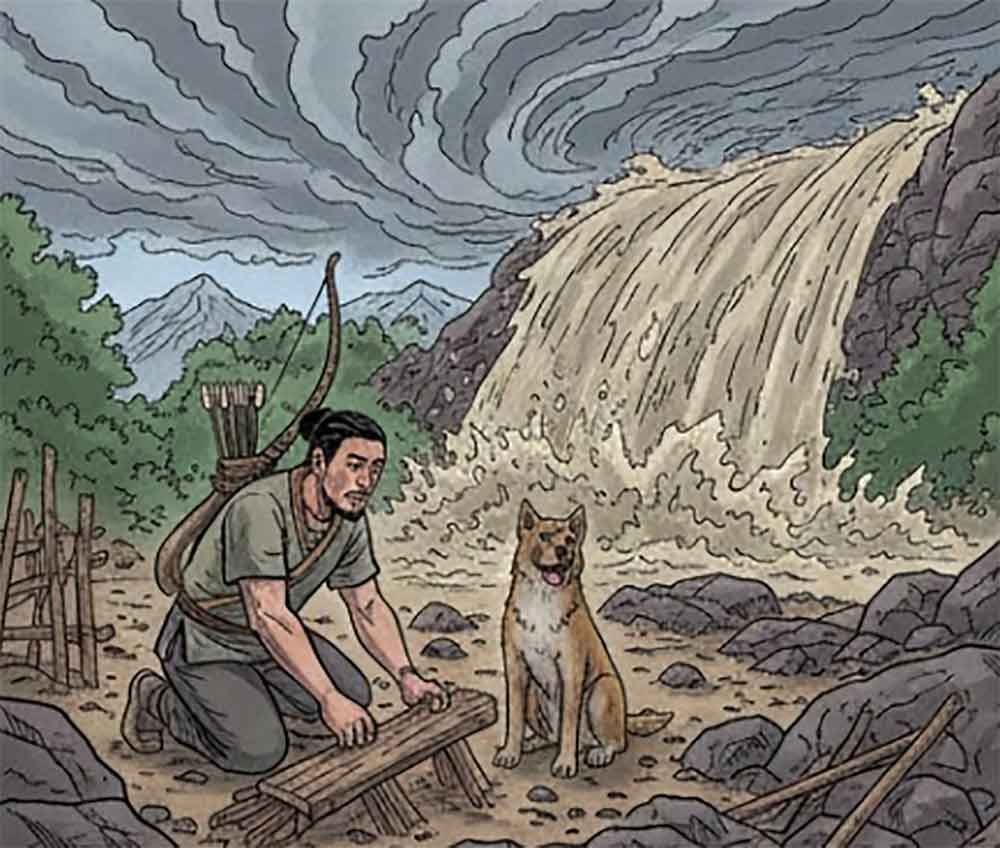
    The ground crossbows Gao Lengqu set never missed their mark; the traps he dug could deceive the craftiest foxes; and the snares he laid could catch two pheasants at once. His fame spread across the nine mountains and eighteen villages. One day, carrying a large bow strung with ox sinew and accompanied by his six-toed hunting dog, he went to a gully frequented by horses and deer to set a crossbow.


    正当他支下地弩的时候,突然轰的一声,山洪暴发了。眨眼间滔天洪水涌满山谷,漫溢到山顶,冲塌了坡坎,高楞趣被埋到了坡坎下面。滚滚洪水淹没了村寨,高楞趣的四个儿子只好逃到大山里。

    Just as he was setting the crossbow, there was a sudden roar as a mountain flash flood erupted. In the blink of an eye, the surging water filled the valley and reached the mountain peaks, causing the banks to collapse and burying Gao Lengqu beneath the debris. The rolling floodwaters submerged the village, forcing Gao Lengqu’s four sons to flee into the high mountains.


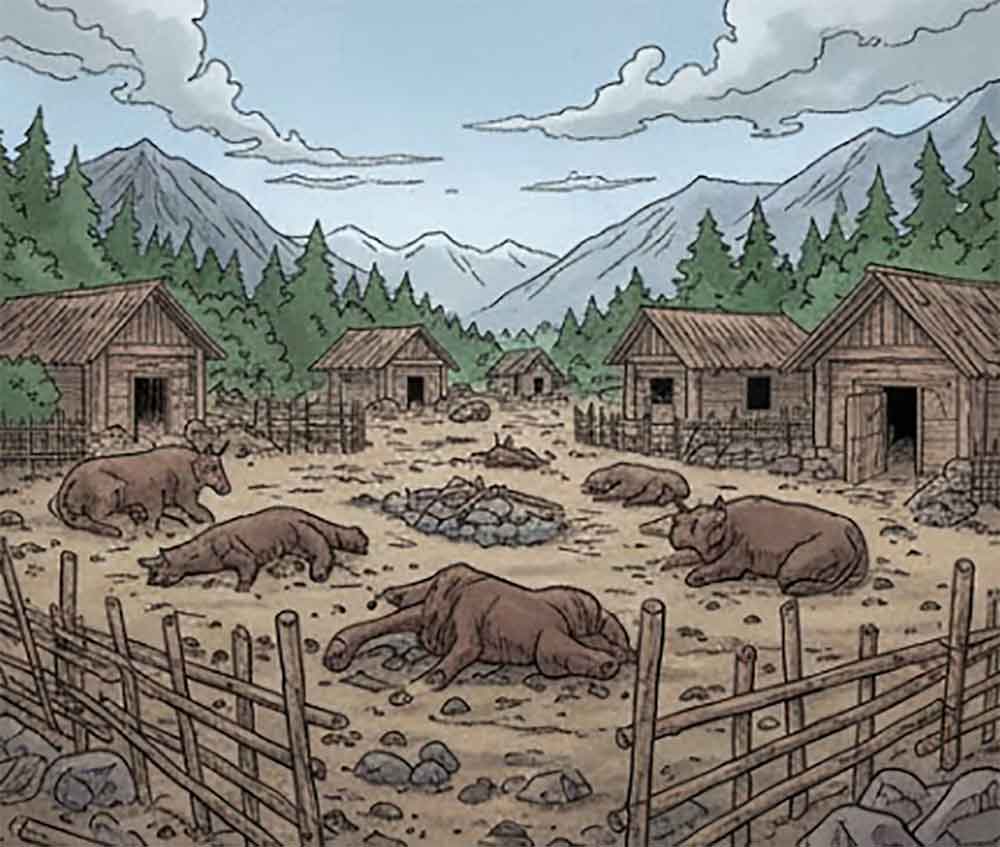
    等到洪水退去,四个儿子回到家里,低矮的木楞房被冲塌了,牲畜和家禽全被淹死了,村寨里只留下枯树桩和石头,荒凉得像一片沙滩。四个儿子只得重新建造自己的家园。三年时光过去了。在辛苦和劳累中,高楞趣的四个儿子没有吃过一顿安逸饭,没有睡过一天安稳觉,没有坐下来谈过一次家常。

    When the floods finally receded, the four sons returned home to find their low timber-framed houses collapsed and their livestock and poultry drowned. The village was left with nothing but dead stumps and stones, as desolate as a stretch of beach. The four sons had no choice but to rebuild their home from scratch. Three years passed. Through hard work and exhaustion, they did not eat a single meal in peace, sleep a single night in comfort, or sit down once to talk of family matters.


    他们流下的汗水,浇出了幸福的硕果:木楞房梁上挂着百种野兽的干肉,牧场里散布着云朵样的牛群和羊群,奶汁像河水一样流淌,酥油和奶酪堆成山,生活像蜜蜂酿成的蜜一样甜。贫困的时候,四个儿子没有工夫寻找失散了的亲人,但是当富裕起来,四人又聚在一起时,他们就加倍思念失踪的老父亲。

    The sweat they shed bore the fruits of happiness: hundreds of types of dried meat hung from the beams of their timber houses, herds of cattle and sheep like scattered clouds dotted the pastures, milk flowed like river water, and butter and cheese were piled like mountains. Life became as sweet as honey made by bees. In times of poverty, the four sons had no time to search for their lost kin, but once they became wealthy and gathered together, they missed their missing father all the more.


    一天,四个儿子邀请村寨里的人到家里做客。当全寨人都环坐在火堆边吃肉喝酒的时候,一份坨坨肉多出来了,一碗斟满甜酒的酒碗也多出来了。是漏请了哪位客人,还是哪个人没有到?高楞趣的四个儿子从寨头算到寨尾,又从寨尾数到寨头,全寨子的人都在座了。

    One day, the four sons invited the villagers to their home for a feast. While everyone sat around the fire eating meat and drinking wine, an extra serving of meat and an extra bowl filled with sweet wine remained. Had a guest been forgotten, or had someone failed to arrive? Gao Lengqu’s four sons counted from the head of the village to the end, and then back again; every person in the village was present.


    当人们捧着酒碗,唱起祝酒歌的时候,高楞趣的四个儿子脸色变了。他们突然想起,这多出来的坨坨肉和酒碗,是自己父亲那一份。他们的泪水像断线的珍珠一般滴落在酒碗里。趣若的哽咽着说:“寻找(梅)阿爸的下落。”在纳西话中,“寻找”讲作“梅”,后来,“梅”就成了老大一支的姓氏。

    As the people held their wine bowls and sang toasting songs, the faces of the four sons changed. They suddenly realized the extra meat and wine belonged to their father. Their tears fell into their wine bowls like broken pearls. Qu Ruodi choked out, “Go find (Mei) our father’s whereabouts.” In the Naxi language, “to search/find” is spoken as “Mei,” and thus “Mei” became the surname of the eldest son’s lineage.


    趣若吕伤心地说:“我们想得太迟(禾)了!”“迟”在纳西话中讲作“禾”,后来,“禾”就成了趣若吕一支的姓氏。趣若斯难过地接着说:“恐怕阿爸的尸体都已经萎缩(束)了。”“萎缩”在纳西话中讲作“束”,后来,“束”就成了趣若斯一支的姓氏。

    Qu Ruolü said sadly, “We thought of this too late (He)!” In the Naxi language, “late” is spoken as “He,” and thus “He” became the surname of Qu Ruolü’s lineage. Qu Ruosi added sorrowfully, “I fear father’s body has already shriveled (Shu).” In the Naxi language, “shrivel/wither” is spoken as “Shu,” and thus “Shu” became the surname of Qu Ruosi’s lineage.


    趣若鲁焦急地抢过话头说:“可能阿爸的尸体已经腐烂(叶)了。”“腐烂”在纳西话中讲作“叶”,后来,“叶”就成了趣若鲁一支的姓氏。四个兄弟商议一番后,老大趣若的骑着一匹黑马去寻找阿爸高楞趣。一天,他在大山里默默地走着,一只金色的蜜蜂在他的耳边兜着圈子,他烦躁极了,抬起手撵蜜蜂,蜜蜂嗡地哼了一声,飞走了。趣若的没有找到阿爸,伤心地骑着黑马回来了。

    Qu Ruolu anxiously interrupted, “Perhaps father’s body has already decayed (Ye).” In the Naxi language, “decayed/rotten” is spoken as “Ye,” and thus “Ye” became the surname of Qu Ruolu’s lineage. After discussing it, the eldest brother, Qu Ruodi, rode a black horse to find their father. One day, as he walked silently through the mountains, a golden bee circled his ear. Irritated, he raised his hand to shoo it away; the bee buzzed a hum and flew off. Qu Ruodi failed to find his father and returned home sadly on his black horse.


    老二趣若吕也骑着一匹黑马去寻找阿爸。他一边走一边把手搭在嘴边,冲着密林呼喊了几百遍,大山响起了呜呜的回声。突然,一只金色的蜜蜂飞来,在趣若吕的耳边兜着圈子,弄得趣若吕也烦躁起来。他扬起马鞭赶蜜蜂,蜜蜂丢下一串哭声,又走了。趣若吕没有找着阿爸,伤心地骑着黑马回来了。

    The second brother, Qu Ruolü, also rode a black horse to search for their father. As he went, he cupped his hands to his mouth and shouted into the dense forest hundreds of times, but only the echoing moans of the mountains answered. Suddenly, a golden bee flew by and circled his ear, making Qu Ruolü irritable as well. He raised his whip to drive the bee away; the bee left behind a trail of crying sounds and departed. Qu Ruolü did not find his father and returned sadly on his black horse.


    老三趣若斯也骑着一匹黑马,捧着一碗祭食,出门去寻找阿爸。他默默地骑在马上,在一片幽静的山谷里走着。金色的蜜蜂又飞来绕着他不住地飞,他烦躁地摇晃着巴掌赶蜜蜂,蜜蜂呜呜地哭着飞走了。趣若斯也没有找着阿爸,只好骑着黑马回来了。

    The third brother, Qu Ruosi, also rode a black horse, carrying a bowl of sacrificial food to search for their father. He rode silently through a quiet valley. The golden bee returned and flew incessantly around him. He waved his hand irritably to drive it off, and the bee flew away with a sobbing sound. Qu Ruosi also failed to find his father and had to return on his black horse.


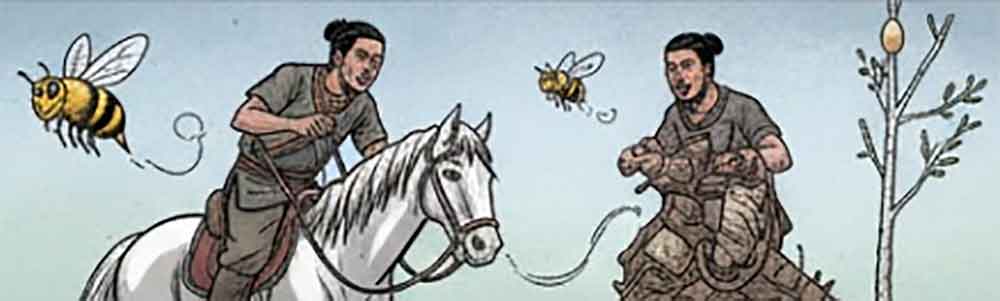
    老四趣若鲁骑着一匹雪白的骏马,也捧着一碗祭食,去寻找阿爸。他一边走一边冲着大山和老林悲伤地呼唤着,他的呼喊声在山间久久回荡。那只金色的蜜蜂又飞来了,在他的耳边悲鸣盘旋。趣若鲁心想:这只蜜蜂也许和阿爸有关。他捧着祭食,虔诚地说:“金子一样珍贵的蜜蜂,雪山一样尊贵的蜜蜂,你若是我阿爸的灵魂,请落在祭食上;若不是阿爸的灵魂,请你赶快飞走吧!”

    The youngest, Qu Ruolu, rode a snow-white steed and also carried a bowl of sacrificial food. As he traveled, he called out sorrowfully to the mountains and forests, his voice echoing for a long time. The golden bee appeared again, mourning and circling his ear. Qu Ruolu thought, “Perhaps this bee is related to my father.” Holding the food, he said reverently, “Golden bee as precious as gold, noble bee as grand as the snow mountains, if you are my father’s soul, please land on this food; if not, please fly away quickly!”


    趣若鲁的话刚说完,蜜蜂在他头顶上转了三圈,然后嗡的一声轻轻地落在了祭食上,瑟瑟地抖动着翅膀,仿佛是一位父亲在对儿子倾吐心里话。趣若鲁将一根白线拴在蜜蜂的腰上(据说,蜜蜂的腰就是被他勒细了的),然后蜜蜂又嗡的一声飞走了。趣若鲁骑着白马,紧紧跟随在蜜蜂的后面。

    As soon as he finished speaking, the bee circled his head three times and then, with a buzz, landed gently on the sacrificial food. Its wings trembled slightly, as if a father were pouring out his heart to his son. Qu Ruolu tied a white thread around the bee’s waist (it is said this is why bees have thin waists) and then the bee buzzed and flew off. Qu Ruolu followed closely behind on his white horse.


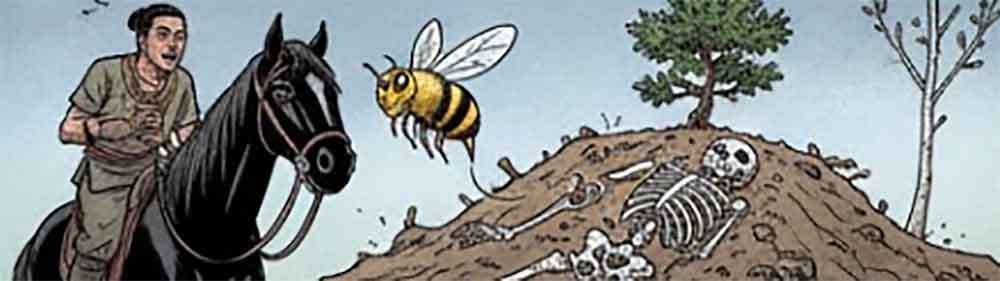
    那只拴着白线的蜜蜂飞到一个塌坡的土堆上,飞了三圈,就隐没到土堆里去了。趣若鲁急忙骑着白马跑回家,把三个哥哥叫到一起,一同来到蜜蜂隐没的土堆前面。他们扒开土堆,终于找到了阿爸高楞趣的尸体。阿爸的脑壳上长着一棵刺柏树,手上长着一棵黄栗树,脚上长着一棵白桦树。

    The bee with the white thread flew to a collapsed mound of earth, circled it three times, and disappeared into the dirt. Qu Ruolu hurriedly rode back home to gather his three brothers. Together they went to the mound and dug it open, finally finding the body of their father, Gao Lengqu. From his skull grew a juniper tree, from his hands grew a yellow chestnut tree, and from his feet grew a white birch tree.


    从此以后,纳西族人遇到在耳边飞鸣的蜜蜂,就认为它是祖先的灵魂,不但不能伤害它,还要向它祈祷,请求祖先保佑。另外,祭天时,要在祭坛中央插一枝刺柏,两边各插一枝黄栗,前面插一枝白桦——顶着一个鸡蛋,表示天地和祖先。

    From then on, whenever Naxi people encounter a buzzing bee near their ears, they believe it is the soul of an ancestor. Not only do they refuse to harm it, but they also pray to it for protection. Furthermore, during the “Sacrifice to Heaven,” a branch of juniper is placed in the center of the altar, with yellow chestnut branches on either side and a white birch branch in front—topped with an egg to represent heaven, earth, and the ancestors.


    四兄弟流着伤心的泪水,给阿爸行了火葬礼,把他的灵魂送到祖先居住的地方。后来,他们分了家,老大趣若的迁到梅墩居住,成为梅氏部落的祖先。老二趣若吕迁到禾墩居住,成了禾氏部落的祖先。老三趣若斯迁到束墩居住,成为束氏部落的祖先。老四趣若鲁迁到叶墩居住,成为叶氏部落的祖先。他们的后裔像五月的青蒲一样,在金沙江峡谷两岸繁衍开来。

    The four brothers, shedding sorrowful tears, held a cremation ceremony for their father and sent his soul to the dwelling place of the ancestors. Later, they divided the family: the eldest, Qu Ruodi, moved to Meidun and became the ancestor of the Mei tribe; Qu Ruolü moved to Hedun and became the ancestor of the He tribe; Qu Ruosi moved to Shudun and became the ancestor of the Shu tribe; and Qu Ruolu moved to Yedun and became the ancestor of the Ye tribe. Their descendants multiplied like green rushes in May along both banks of the Jinsha River.

  • The Legend of the White Snake 白蛇传奇

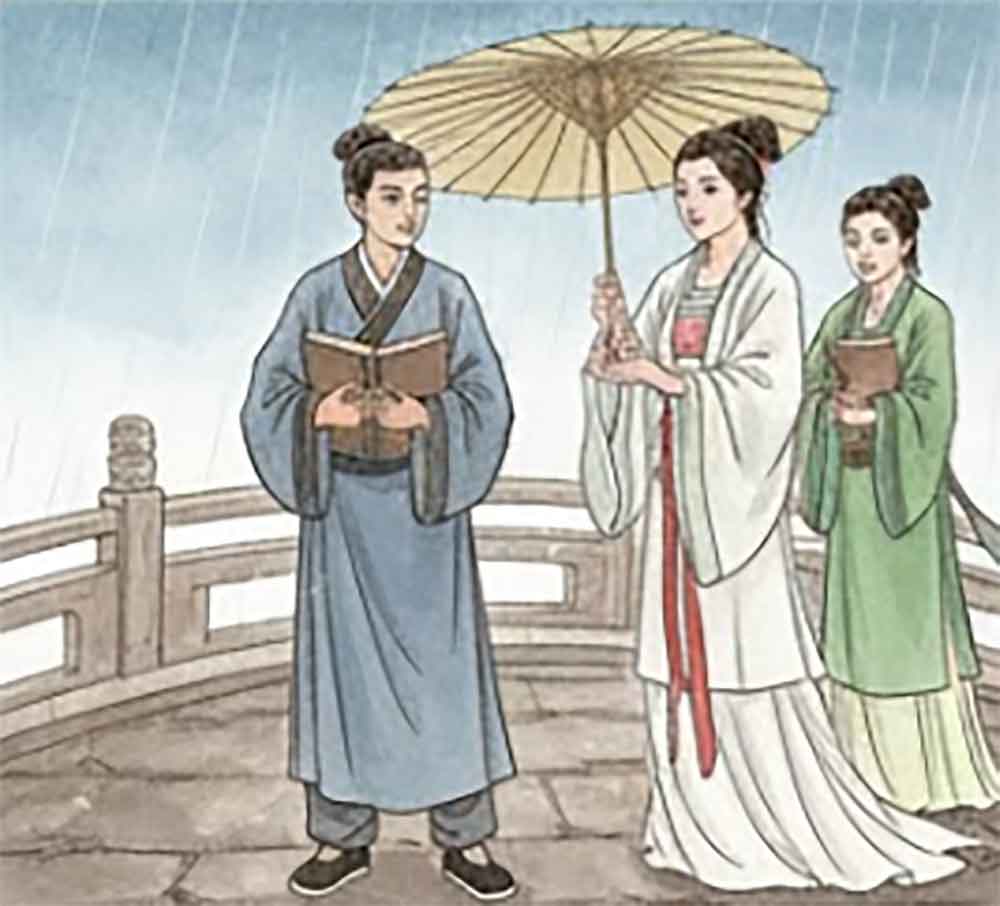
    西湖开始下起雨来,书生许仙没有带伞,抱着手中的书在雨里急急忙忙地跑着,想去前面的亭子躲雨。结果在石桥上撞到了两个女子,一个穿着白色的衣服,一个穿着青色的衣服。他连忙道歉,那个穿白衣的看着像小姐的女子大方地说:“没关系,公子没带伞,我们借你一把吧。”

    Rain began to fall over the West Lake. A scholar named Xu Xian, who had no umbrella, ran hurriedly through the rain clutching his books, hoping to find shelter in a nearby pavilion. On a stone bridge, he accidentally bumped into two women; one was dressed in white, and the other in green. He apologized profusely. The lady in white, who looked like a person of high status, said generously, “It is no matter. Since you have no umbrella, sir, let us lend you one.”

    说完,她就把手中的伞递给了许仙,然后和那个丫鬟模样的青衣女子共撑一把伞。许仙问:“请问小姐叫什么名字?住在哪里?我怎么去还伞呢?”白衣女子笑着说道:“我叫白素贞,这是我的丫鬟小青。如果有缘,我们定会再相见。无缘的话,这伞你就拿去,我们也不缺这一把。”说完就走了。

    With that, she handed her umbrella to Xu Xian and shared another one with the girl in green, who appeared to be her maid. Xu Xian asked, “May I ask your name, miss? Where do you live? How can I return this to you?” The lady in white smiled and replied, “My name is Bai Suzhen, and this is my maid Xiao Qing. If fate decrees, we shall meet again. If not, then keep the umbrella; we do not lack for another.” Having said this, she departed.

    许仙看着她们远去的背影,觉得两个人美得像天上的神仙,尤其是那个白衣小姐,简直比神仙还美丽。从那以后,许仙总是随身携带这把伞,他想:要是碰到了,好还给人家。终于,他们又碰到了,这回,丫鬟小青很大胆,她问道:“许公子成家了没有?”许仙忙害羞地摇了摇头。

    Watching their receding figures, Xu Xian felt they were as beautiful as celestial immortals—especially the lady in white, who seemed even more radiant than a goddess. From then on, Xu Xian carried the umbrella with him everywhere, thinking that if he encountered them again, he could return it. Finally, they met once more. This time, the maid Xiao Qing asked boldly, “Master Xu, are you married?” Xu Xian shook his head bashfully.

    小青哈哈大笑,问道:“你看我家小姐怎么样?”许仙羞红了脸。小青便明白了他的心意,撮合他俩成了婚。小青怎么这么快就撮合他们成亲呢?原来,这两位女子是两条蛇修炼千年而变成的。白蛇修炼到五百年的时候不小心被一个捕蛇人抓住了,多亏一个小牧童救了她一命。

    Xiao Qing laughed heartily and asked, “What do you think of my mistress?” Xu Xian’s face turned crimson with shyness. Seeing his heart’s desire, Xiao Qing acted as a matchmaker and brought them together in marriage. Why was Xiao Qing so quick to arrange their union? It turns out these two women were actually snakes who had cultivated for a thousand years to take human form. When the White Snake had reached five hundred years of cultivation, she was caught by a snake catcher, but her life was saved by a young cowherd.

    现在,她修炼成精,特地来寻找那个小牧童报恩。后来,她终于找到了许仙。原来,小牧童经过轮回转世,如今已成为一位书生。许仙和白素贞成家后,开了一家药铺。他家的药很有效,而且不贵,所以药铺的生意红红火火的。这引起了金山寺住持法海禅师的嫉妒。

    Now, having attained spiritual powers, she had come specifically to find that cowherd to repay his kindness. She eventually found Xu Xian, for the cowherd had been reincarnated and was now this very scholar. After getting married, Xu Xian and Bai Suzhen opened a pharmacy. Their medicine was highly effective and affordable, making the business flourish. This aroused the jealousy of Fa Hai, the abbot of Jinshan Temple.

    原来,以前人们生病了都到金山寺去祈福,现在人们都到许仙那儿去抓药,不来金山寺了,金山寺的香火冷清了许多。许仙的药怎么那么有效呢?法海掐指一算,知道了白蛇、青蛇的来历,便计上心来。端午节到了,小青躲去山洞了。许仙在路上碰见了法海,便提了雄黄酒回来。

    Previously, people would go to Jinshan Temple to pray when they were ill, but now they went to Xu Xian’s pharmacy for medicine, leaving the temple’s offerings and incense altars deserted. Wondering why Xu Xian’s medicine was so potent, Fa Hai performed a divination and discovered the true origins of the White and Green Snakes, and a scheme began to form in his mind. When the Dragon Boat Festival arrived, Xiao Qing hid in a cave. Xu Xian, having encountered Fa Hai on the road, brought home some realgar wine.

    白素贞最怕雄黄酒,不想喝。许仙说:“有一个和尚说我家娘子是蛇精,娘子你喝喝,证明给他看你不是什么蛇精。”白素贞不得已喝了雄黄酒。她本来想,以她的法力应该不会现出原形,却不想因为有了身孕,身体虚弱,喝了雄黄酒后便现出了原形。许仙看到后,吓得倒在地上,死了。

    Bai Suzhen feared realgar wine and did not want to drink it. Xu Xian said, “A monk told me my wife is a snake spirit. Dear wife, drink this to prove to him that you are no such thing.” Left with no choice, Bai Suzhen drank the wine. She thought her magical powers would prevent her from transforming, but she did not realize that her pregnancy had weakened her. After drinking the wine, she reverted to her original form. Upon seeing this, Xu Xian was terrified to death and collapsed on the floor.

    白素贞醒来后知道了是怎么回事,她正伤心,突然想到南极仙翁那里有起死回生的仙草。她叫回小青,不顾危险,飞去了峨眉山。白素贞刚刚偷到仙草准备回去,却被南极仙翁发现了,她跪在地上把自己的经历和遭遇告诉了仙翁。仙翁虽然知道她是蛇精,但是被她感动了,便让她拿着仙草回去救许仙。

    When Bai Suzhen woke up and realized what had happened, she was heartbroken. Suddenly, she remembered that the Immortal Old Man of the South Pole possessed a magical herb that could bring the dead back to life. She summoned Xiao Qing and, despite the danger, flew to Mount Emei. Just as she had stolen the herb and was preparing to leave, she was discovered by the Immortal. She knelt and told him of her life and her plight. Though he knew she was a snake spirit, the Immortal was moved by her devotion and allowed her to take the herb to save Xu Xian.

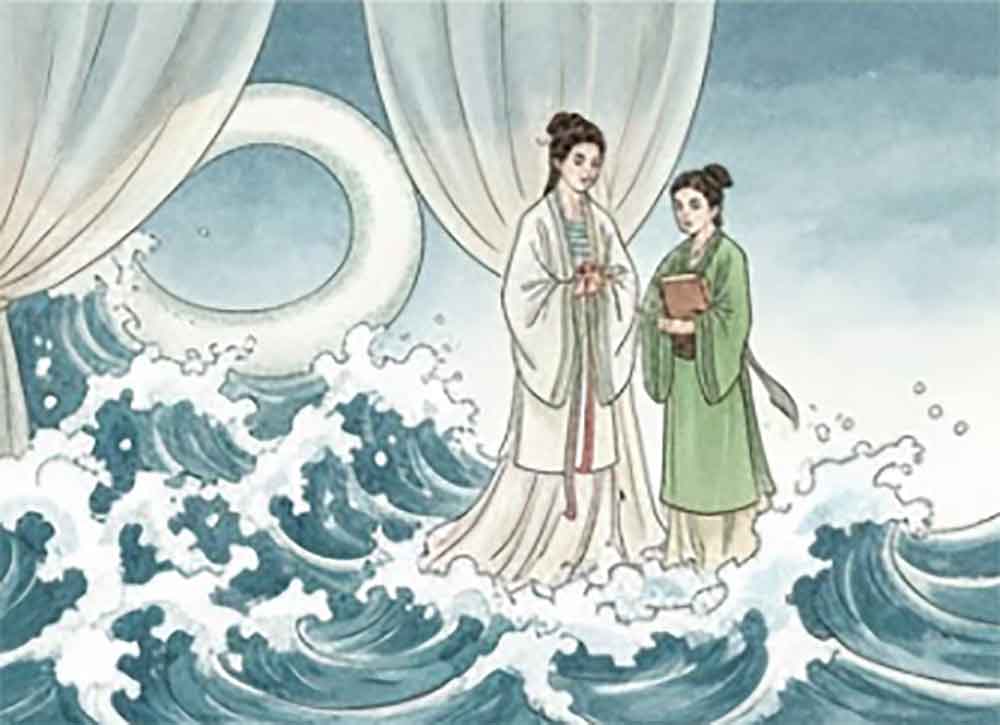
    白素贞把许仙救醒,然后变出一条白蛇,让许仙相信把他吓死的不是她,而是那条白蛇。法海没有得逞,又想到一个办法,他把许仙骗到金山寺关了起来。白素贞急了,带着小青一起去救许仙,用法力从东海引来海水淹了金山寺,威胁法海放许仙出来。

    Bai Suzhen revived Xu Xian and then conjured a different white snake, convincing him that the creature which had scared him to death was not her, but that other snake. Having failed in his first attempt, Fa Hai devised another plan: he lured Xu Xian to Jinshan Temple and imprisoned him. Distraught, Bai Suzhen took Xiao Qing to rescue him. She used her powers to summon water from the East Sea to flood the temple, threatening Fa Hai to release her husband.

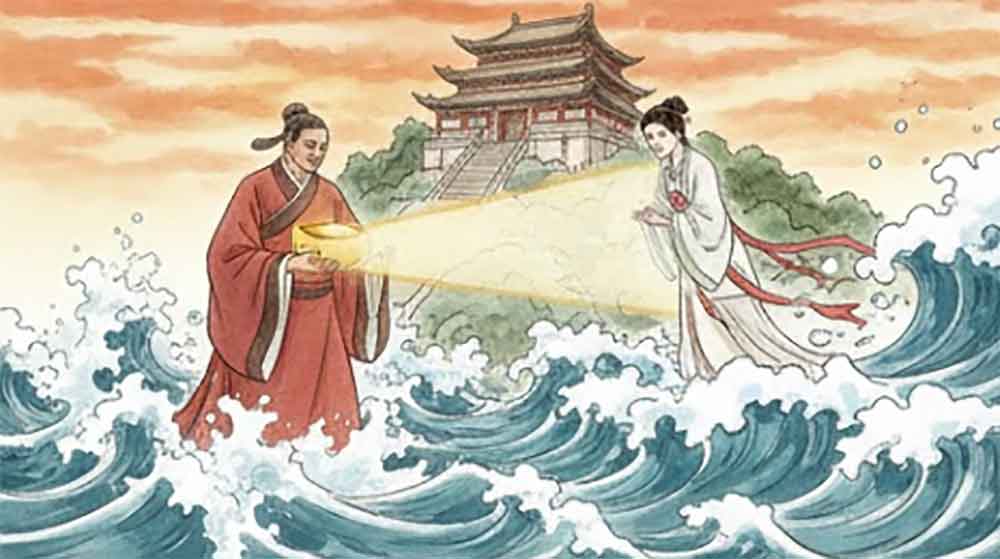
    法海拿出一个金光闪闪的钵,对着白素贞照。白素贞被金光照得痛苦地缩成一团,肚子里的孩子这时也生了下来。白素贞再也支撑不住,被金钵吸了进去。法海将她压在了雷峰塔下。许仙知道了自己的娘子是蛇精,但他想到以前娘子为百姓做了那么多的好事,便不觉得害怕了,他觉得娘子是个好妖。

    Fa Hai produced a shimmering golden alms bowl and cast its light upon Bai Suzhen. Under the intense light, she curled up in agony, and in that moment, she gave birth to her child. Unable to resist any longer, she was sucked into the golden bowl. Fa Hai then imprisoned her beneath Leifeng Pagoda. Xu Xian now knew for certain his wife was a snake spirit, but remembering all the good deeds she had done for the people, he was no longer afraid; he believed his wife was a benevolent spirit.

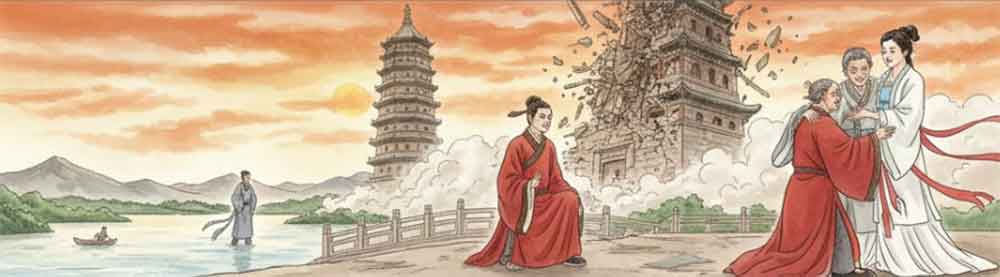
    后来,许仙一个人把儿子养大成人。十八年后,许仙和白素贞的儿子高中状元。新科状元回乡,一到杭州城,便直奔雷峰塔。他每走三步便磕一个响头,哭喊着:“娘,孩儿来看您了。”这一磕不要紧,只见雷峰塔剧烈地摇晃了起来。法海知道这是上天的旨意,他再也不能做什么了,于是灰溜溜地跑了。

    Years passed, and Xu Xian raised their son alone. Eighteen years later, the son achieved the top score in the imperial examinations. Upon returning to his hometown of Hangzhou, the new top scholar went straight to Leifeng Pagoda. Every three steps, he performed a full prostration, crying out, “Mother, your son has come to see you!” As he kowtowed, the pagoda began to shake violently. Recognizing this as the will of Heaven, Fa Hai realized he could do nothing more and fled in disgrace.

    轰的一声,雷峰塔倒了,白素贞被救了出来,她抱着许仙和儿子又哭又笑。

    With a thunderous crash, Leifeng Pagoda collapsed. Bai Suzhen was finally freed, and she held Xu Xian and their son close, weeping and laughing with joy.